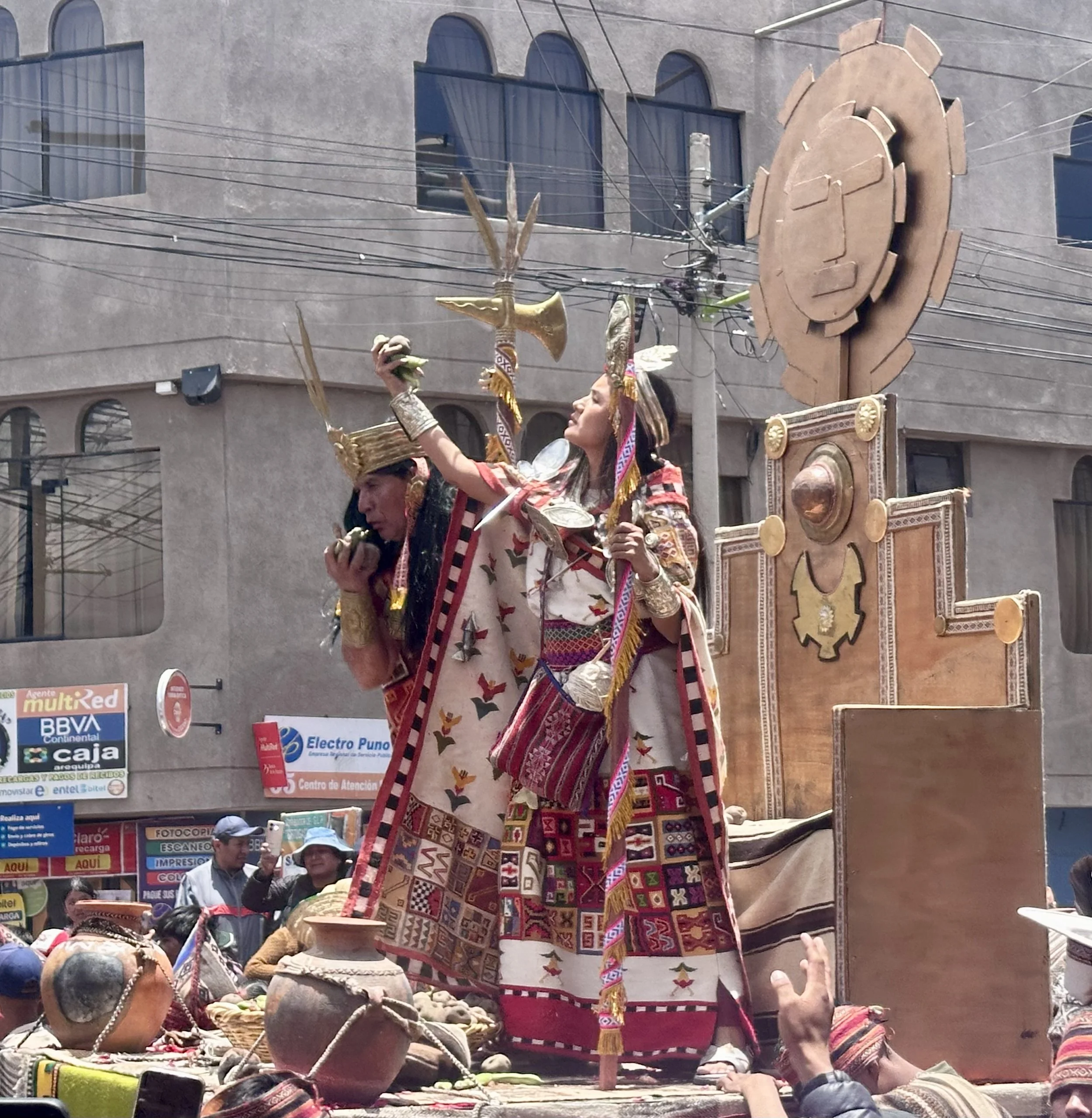
Manco Cápac and Mama Ocllo handing out corn and potatoes for good luck and agricultural abundance, during the reenactment in Puno
I’ve long been interested in the idea of dualities - conscious/unconscious, living/dying, masculine/feminine, light/shadow, yin/yang - and what lies in between. It seems to me that the mid-point between two seeming opposites is the most fertile territory of all, for feeding our curiosity and understanding each side better. A bit of this, a bit of that. Where do the two edges start to overlap and merge? What new thing is created in that space, and how do we describe it?
I didn’t realise that I’d be exploring these things on my recent journey to Peru, too! This idea of opposing but complementary forces popped up all along the way.
I had assumed that because the Quechua people worship Pachamama, (Mother Nature, the Earth Goddess) we’d experience a very feminine-leaning spiritual culture with imagery to match. However, when I booked two rituals with an indigenous Andean Pampamisayoq (priest/Earth-keeper), I discovered that everything is about balance.
The Earth-keeper carries a ‘mesa’, which is the Spanish word for table, but in this case it means a ‘cloth of power’ - a sacred altar cloth which doubles as a bundle for herbs and precious stones. For my first ritual, the mesa used was split into two halves down the middle. Black on one side, white on the other, with a rainbow motif (used a lot by the Incas) around the edge. I immediately noted the importance of those two sides, noticing how the priest cast coca leaves onto the center line for divination and then read them according to where the leaves fell.
In the second ritual, we made offerings of reciprocity in the form of a colourful, flavourful, aromatic sacred bundle to be burnt on the fire. Again, there were two halves. One half was for the feminine Pachamama - filled with bright hues and gold - and the other was for the masculine, in white and silver.
Elsewhere, in an Arequipa museum about a mummified young girl who had been offered as a human sacrifice, I learned about the concept of ‘Hanan’ and ‘Hurin’ (or ‘Urin’) - meaning above/upper and below/lower. These two concepts were found throughout Inca civilisation as a way to talk about and organise their cosmos, society and politics.
Hanan and Hurin’s opposing but complementary natures are reflected in the masculine sun god Inti and the feminine moon goddess Mama Quilla, and it is said that the two exist in harmony like siblings, rather than at odds with each other.
In Ollantaytambo, a popular stopping off point for Machu Picchu, we admired the many beautiful handmade tapestries and got curious about the symbols and the stories they told. We chose one based on the colours and sumptuous patterns, only to discover that it was a matrimonial design with the two ducks at the centre representing - you guessed it - the union of masculine and feminine.
And finally, in Puno, there was the spectacular 500+ actor-strong reenactment of Manco Cápac and Mama Ocllo’s emergence from Lake Titicaca. This is the creation myth of the Incan empire, involving the sun god Inti’s son and daughter coming ashore from the water to share skills - Manco Cápac teaching the men to farm, and Mama Ocllo teaching the women to weave. Ever felt like a message is following you around?
As someone who has felt many times that aspects of my nature were at odds with each other, or that different parts of me wanted different things, I really appreciate a world view that takes into account the binaries, spectrums and dualities that co-exist within us all. Life is never just one or the other (of anything), and neither are we.
I’m ready for more nuance, are you? Let’s make more space for the in-between.
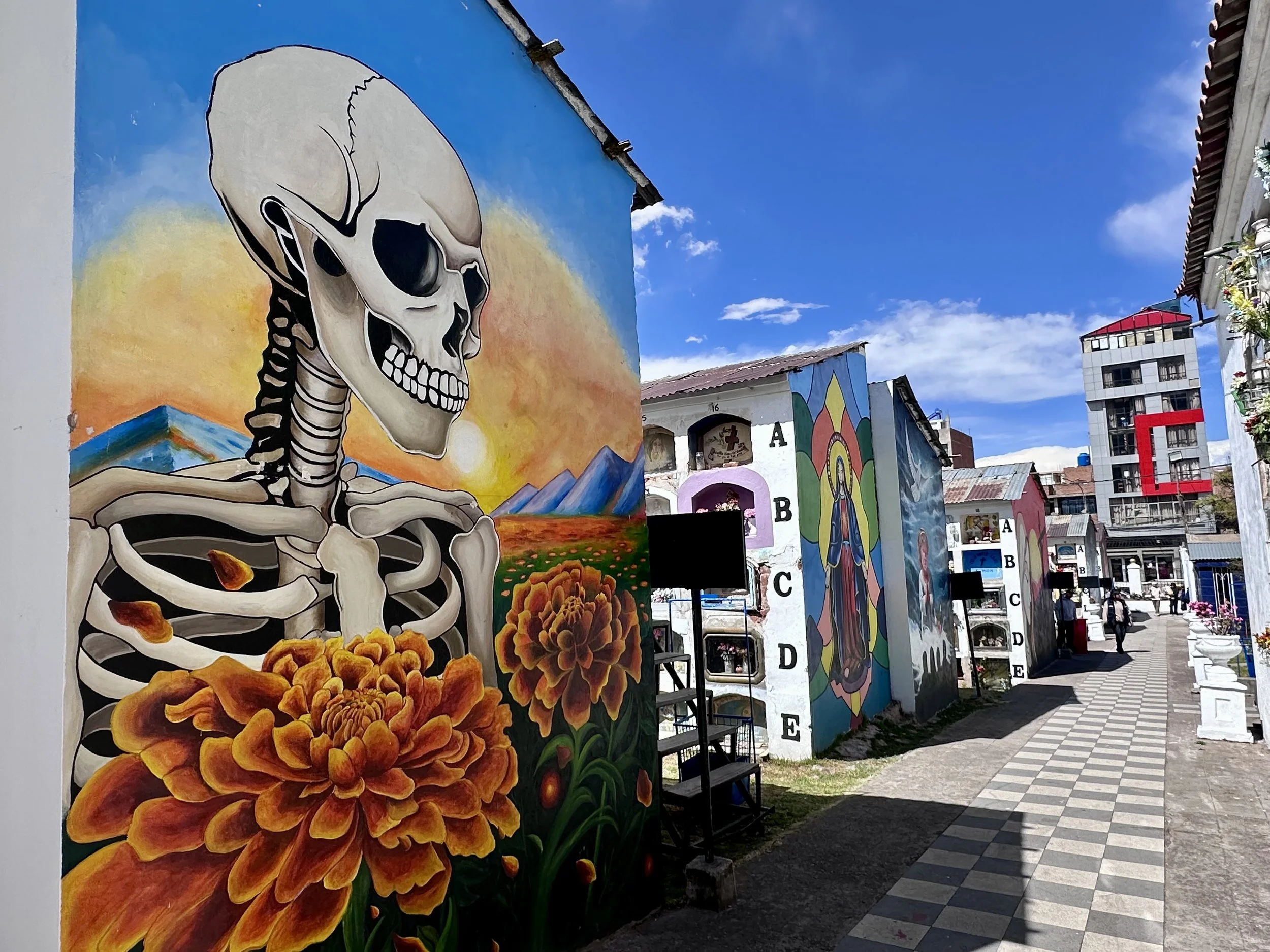
Puno’s Municipal Cemetery on their day of the dead, known as Dia de los Difuntos, or ‘Day of the Departed’. We saw many people straddling the line between life and death by tending to their loved ones’ mausoleums and niches, refreshing flowers and leaving offerings of beer and special breads.